Reviews
User Score
Rate This
Descriptions:
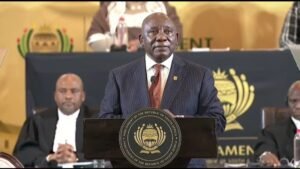
In a heated and contentious debate, Julius Malema, the leader of the Economic Freedom Fighters (EFF) party in South Africa, accused President Cyril Ramaphosa of being a “sellout.” This accusation was made in the context of a discussion about the Government of National Unity (GNU), a coalition formed after the end of apartheid to transition South Africa to a fully democratic state.
Malema’s critique of Ramaphosa centers on the belief that Ramaphosa has betrayed the revolutionary ideals and the economic emancipation goals set by the liberation movement. Malema argues that Ramaphosa, instead of championing the needs and aspirations of the poor and marginalized majority, has aligned himself with the interests of big business and international capital. This alignment, according to Malema, has perpetuated economic inequalities and hindered genuine transformation in post-apartheid South Africa.
Malema’s use of the term “sellout” is particularly provocative and evocative in the South African context. It implies that Ramaphosa has compromised or abandoned the struggle for which many fought and died during the anti-apartheid movement. This accusation taps into deep-seated frustrations among those who feel that the promises of the democratic transition and the GNU have not been fulfilled, especially in terms of land redistribution, economic justice, and the eradication of poverty.
The debate also touches on the legacy and the effectiveness of the GNU itself. While the GNU was instrumental in ensuring a peaceful transition and avoiding a potential civil war, its critics argue that it did not sufficiently dismantle the economic structures of apartheid. Instead, it is argued, it allowed the continuation of economic policies that favored a small elite, both white and black.
Ramaphosa, a key negotiator during the transition period and a wealthy businessman before becoming president, embodies these complexities. His critics, like Malema, see him as a symbol of the compromises that were made, which they believe have resulted in the persistence of deep social and economic divides.
Supporters of Ramaphosa, on the other hand, argue that his leadership has brought stability and has been marked by efforts to tackle corruption and improve governance. They see his approach as pragmatic, balancing revolutionary ideals with the practicalities of governing a diverse and complex society in a globalized world.
The clash between Malema and Ramaphosa in this debate thus reflects broader tensions within South African society and politics: between radical transformation and pragmatic reform, between revolutionary ideals and the compromises of governance, and between different visions for the country’s future.




Premium Content
Julius Malema, accused President Cyril Ramaphosa of being a sellout.
Report
Afrotube
13SubscribersLive Comments